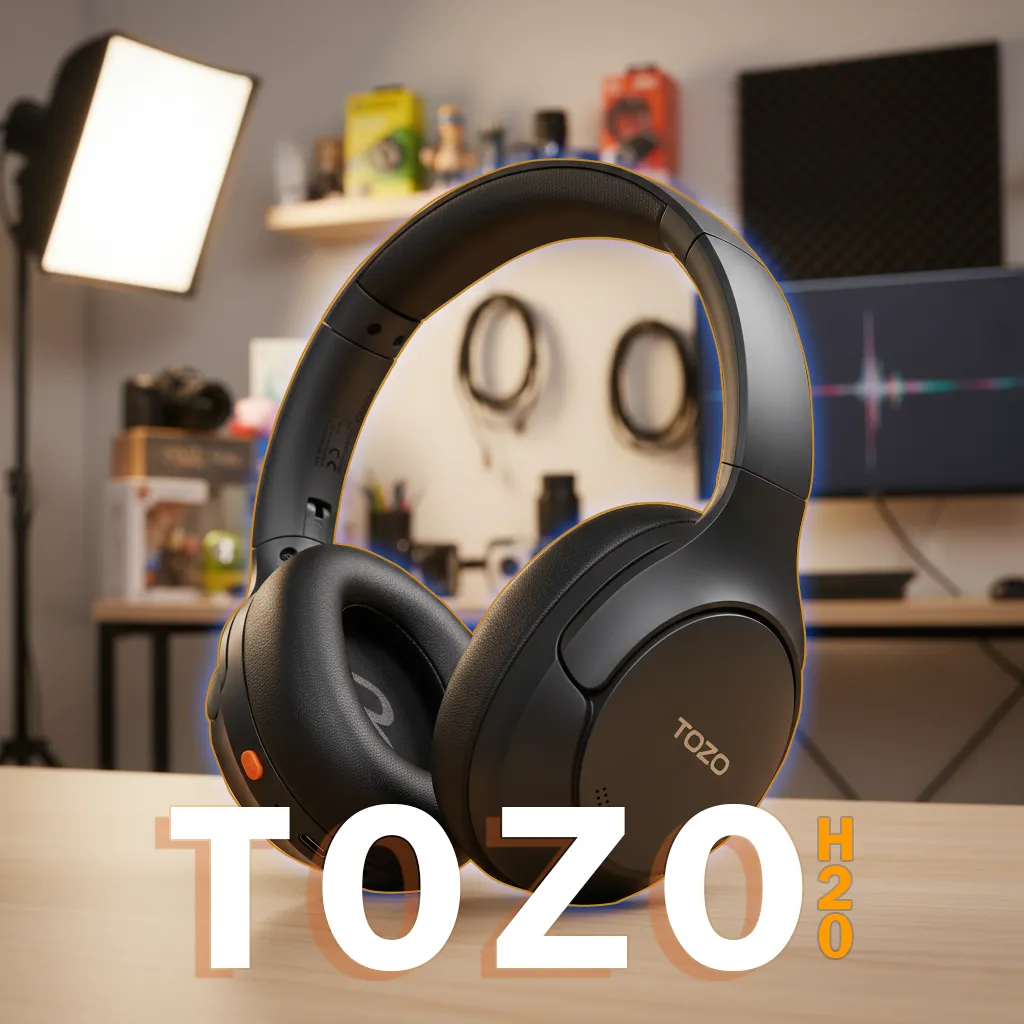
Looking for ANC headphones under Rp1 million often comes down to two names: Tozo H20 and Earfun Tune Pro. Both are “reasonably effective,” but the reviewer finds the Tune Pro slightly more effective at reducing high frequencies. Transparency exists, but it’s not the main selling point at this price. So, which one fits your daily needs better? Check the ANC, sound, comfort, features, and price trade-offs before deciding.
Editorial Verdict
A synthesis of gadget reviewer opinions highlighting key strengths and trade-offs.
Two balanced budget-class ANCs: Tune Pro seals highs a bit better; H20 wins on features and battery life.
Best for:
- Daily ANC focus with a preference for high-frequency attenuation (Earfun Tune Pro)
- Users who want long battery life + LDAC + an app ecosystem with shared EQ (Tozo H20)
- Seekers of a looser clamp for comfort (Earfun Tune Pro)
Not ideal for:
- Fans of very high volumes who are treble-sensitive (H20 can feel sharp)
- Those seeking transparency on par with premium class
Final verdict:
Choose Tune Pro if your priority is isolation; choose H20 if you need a full feature package and super-long battery life.
| # | Product | Price (est.) | Key strengths | Best for |
|---|---|---|---|---|
| 1 | Tozo H20 | ±Rp900 thousand (can drop to ±Rp800 thousand on discount) | Very long battery life; LDAC; app with preset/EQ sharing; easy-to-replace earpads; USB‑C wired mode | Mobile users prioritizing features and day‑to‑day durability |
| 2 | Earfun Tune Pro | <Rp1 million (cheaper than H20) | ANC slightly tighter (especially highs); looser clamp; softer earpads; more pronounced sub‑bass character | Users seeking comfort plus better high‑frequency attenuation |
Check Price & Availability
Buy on tokopedia Buy on shopee*Prices may change at any time according to marketplace policies.
Market context and expectations
In this price range, realistic ANC expectations are “good enough” for office, commuting, and indoor spaces—not yet on par with top-tier Sony. According to the reviewer, the Tozo H20 and Earfun Tune Pro are on the same level, with a small edge to Tune Pro for high-frequency reduction. Both have transparency, but it’s not the best in class.
ANC: Tozo H20 vs Earfun Tune Pro
- Attenuation pattern: Both are judged similar for overall isolation. The difference is that the Earfun Tune Pro feels slightly better at high-frequency attenuation (hiss/sharper crowd noise).
- Real-life quality: The ANC “feels like it works,” but isn’t wow; suitable for cutting general noise.
- Transparency: Present on both models, but not the main focus; most users in this segment typically prioritize isolation.
Tozo H20 — feature bundle and ultra‑long battery
Key advantages:
- Battery life: Up to ±55 hours with ANC on, and much longer with ANC off (the reviewer notes a significant increase).
- Connectivity: Bluetooth “6.0” upgrade over 5.3 (said to impact power efficiency/stability); LDAC support; dual device connection; USB‑C wired mode; low-latency option.
- App: 10‑band EQ with preset sharing (EQ Zone).
- Build: Earpads are easy to swap and compatible with H10; Tozo sells official earpads.
Drawbacks/trade‑offs:
- Tonality: Mid‑ to sub‑bass sounds thick, so it can feel muddy/bloated at higher volumes; there’s sharpness around 8–10 kHz.
- EQ limits: The app doesn’t offer specific 8/10 kHz control (it jumps from 6 to 12 kHz), making that sharp area hard to bring down precisely.
- Comfort (relative): Clamp isn’t harsh, but it’s not the plushest compared to Tune Pro.
- In-box: No carrying case included.
Who is it for:
- Users prioritizing long battery life, LDAC, and preset-sharing EQ; listening at moderate‑to‑low volumes.
Earfun Tune Pro — slightly better at highs, roomier on the head
Key advantages:
- ANC: Slightly better attenuation, especially at high frequencies.
- Comfort: Looser clamp; earpads feel softer/smoother.
- Sound: Sub‑bass stands out more than mid‑bass; the 4–6 kHz region is more forward (adds presence).
- Price: Generally cheaper than H20.
Drawbacks/trade‑offs:
- Codec: No LDAC support (according to the reviewer).
- In-box: No carrying case.
- Technical tier: Overall in the same class as H20—no big leap.
Who is it for:
- Users needing day‑to‑day ANC with priority on high-frequency attenuation, roomier comfort, and a friendlier price.
Sound and EQ: what to consider
- Tozo H20: Mid‑bass (around 100–150 Hz) is more prominent with strong punch; sub‑bass is present but the overall impression can get less clean at high volume. There’s sharpness at 8–10 kHz; since 8/10 kHz bands aren’t available in the app EQ, you can only “sweep” it via 6–12 kHz adjustments and trim around 200 Hz to tidy the mid‑bass. Separation/layering on H20 is cleaner than the earlier H10.
- Earfun Tune Pro: Sub‑bass is more noticeable than mid‑bass; presence in 4–6 kHz is more forward. The app (according to the reviewer) allows an 8 kHz adjustment, making it more flexible to tame sibilance/presence.
Volume note: The reviewer suggests enjoying H20 at moderate‑to‑low volumes so the treble doesn’t feel spicy and the low end doesn’t get messy.
Comfort, build, and accessories
- Headband/clamp: Tune Pro is a bit roomier; H20 remains comfortable but feels more “grippy.”
- Earpads: Tune Pro is softer; H20 wins on easy pad swapping and availability of official earpads (and compatibility with H10).
- Case: Neither includes a carrying case.
Features and battery
- Tozo H20: LDAC, Bluetooth “6.0” upgrade (claimed impact on efficiency/stability), multipoint (dual device), low‑latency mode, and USB‑C wired mode. Very long endurance: ±55 hours with ANC on and far longer without ANC, according to the reviewer.
- Earfun Tune Pro: Focuses on ANC/comfort; no LDAC per the reviewer. Battery details weren’t discussed specifically.
Microphone
Both were briefly tested outdoors with traffic. The review doesn’t emphasize mic differences, so microphones aren’t a key differentiator here.
GizmoKita Insight
Who it’s for:
- Earfun Tune Pro: If your priority is slightly better high-frequency attenuation and a looser clamp for comfort.
- Tozo H20: If you want a complete feature set (LDAC, multipoint, wired mode), long battery life, and an app ecosystem with shared EQ.
Who it’s not for:
- Users very sensitive to sharp treble (H20).
- Seekers of best‑in‑class premium transparency.
Trade‑offs:
- ANC: Same class, but Tune Pro is slightly better in highs.
- Features: H20 is richer and longer‑lasting; Tune Pro is simpler.
- Sound: H20 has punchy mid‑bass (may need EQ cleanup), Tune Pro has more dominant sub‑bass and a more forward 4–6 kHz presence.
Quick Summary (TL;DR)
- ANC: Both effective for the class; Tune Pro isolates high frequencies a bit better.
- Features: H20 is more complete (LDAC, multipoint, USB‑C wired, EQ sharing).
- Sound: H20 emphasizes mid‑bass and is sharp at 8–10 kHz; Tune Pro emphasizes sub‑bass with a forward 4–6 kHz presence.
- Comfort: Tune Pro is roomier and softer; H20 is comfy but grippier.
- Price: Tune Pro is cheaper; H20 around Rp900 thousand (discounts can bring it to the Rp800s).
- Accessories: Neither includes a case.
GizmoKita Verdict: Worth Buying or Not?
Worth it, both. Choose Earfun Tune Pro if your main mission is daily ANC with slightly better high-frequency attenuation and a roomier fit. Choose Tozo H20 if you want a complete feature combo, LDAC, and very long battery life—with the caveat to enjoy it at moderate‑to‑low volumes or use EQ to tidy up mid‑bass/treble.
Alternatives/Other options (optional)
- Soundpeats Space Pro (according to the reviewer): Smoother treble, slightly weightier vocals; used to be around Rp600k then rose to Rp800k; supports LDAC. Official earpads aren’t sold separately.
FAQ
Which one blocks AC/airflow noise (high‑frequency hiss) better?
According to the reviewer, the Earfun Tune Pro is slightly better at high-frequency attenuation.
Is transparency on both good enough for conversations?
It’s there and works, but it’s not a main selling point in this class; most users look for isolation first.
Is their ANC on par with flagship brands?
Not yet. Both are decent for the price; they cut daily noise well but aren’t premium level.
If I often listen loud, which is safer from spicy treble?
The reviewer suggests enjoying H20 at moderate‑to‑low volume because the 8–10 kHz area can feel sharp; the Tune Pro has a more forward 4–6 kHz presence.
Are there app settings that help ANC/comfort?
On H20, the app offers several modes (ANC/Normal/Wind/Transparency) plus a 10‑band EQ; to tame the sharp 8–10 kHz treble, adjustments can only be indirect (6–12 kHz). The Tune Pro allows 8 kHz adjustment according to the reviewer.
Closing: Under Rp1 million, both are safe picks—just set your priority: slightly better isolation (Tune Pro) or features + super‑long battery (H20).
Source: Fernanda Gunsan